Address
304 North Cardinal St.
Dorchester Center, MA 02124
Work Hours
Monday to Friday: 7AM - 7PM
Weekend: 10AM - 5PM
Address
304 North Cardinal St.
Dorchester Center, MA 02124
Work Hours
Monday to Friday: 7AM - 7PM
Weekend: 10AM - 5PM


 Byadmin
Welkite, Ethiopia – June 14, 2025 (Gurage Zone Calendar: Sene 7, 2017 E.C.) – This past week, transport hubs witnessed an unusual surge in travelers, particularly those heading to the Gurage Zones for the Eid al-Adha (Arafa) festival. This annual event is one of the most anticipated occasions for Gurage natives to reunite with their families and ancestral lands.
The Arafa festival holds deep cultural significance in the Gurage Zones, known for its unique celebration. It’s a time when many Gurage people, predominantly known for their business acumen, return home, sometimes even causing major markets elsewhere to quieten down due to their absence. The festival is highly anticipated as it serves as a cherished occasion for families, often separated for long periods, to reconnect.
According to Bruktawit Tsegaye, Head of the East Gurage Zone Culture and Tourism Department, preparations for the Arafa festival in the zone begin months in advance. Mothers, fathers, and youth all make various arrangements individually. These preparations culminate in welcoming and hosting family members who arrive to celebrate the holiday. On the day of the festival, it’s customary for those who can afford it to share meat with the less fortunate.
Bruktawit describes the pre-festival preparations as “beautiful and vibrant,” emphasizing that Arafa is one of the most uniquely celebrated holidays in the zone. This year, the Eid al-Adha Arafa festival was jointly celebrated by both Gurage Zones within the Central Ethiopia Region on May 26 and 27 in the East Gurage Zone.
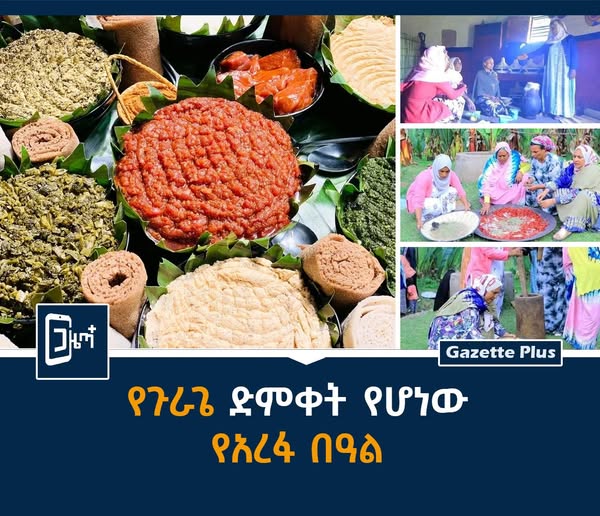
Among these preparations is the “Women’s Arafa,” celebrated on the eve of the festival. On this day, women prepare traditional dishes such as “Gomen” (collard greens), “Kitfo” (minced raw meat), and “Ayib” (local cheese) for their families. They also share the food they’ve been preparing for months and spend time eating and drinking with people of other faiths, fostering a spirit of togetherness.
The sacrificial ritual on the day of the festival, she explained, is performed after blessings from the elders. Before the meat is brought into the owner’s home, it is first shared with those in need. Once the meat is brought in, depending on the local custom, “Kurt” (raw meat pieces) is often eaten first, followed by “Kitfo.”
East Gurage Zone is particularly renowned for its special preparation of Kitfo, which was previously recognized as an African culinary marvel. Bruktawit noted that despite the East Gurage Zone being newly established, this year’s Arafa celebration successfully showcased the zone’s traditional heritage. This included introducing traditional foods, the customary reconciliation process, pre-festival preparations by women and youth, the elders’ preparations, and promoting the zone’s tourist destinations.
She highlighted that representatives from both Gurage Zones were present at the joint celebration, and guests from neighboring areas were also invited to partake in the festivities.